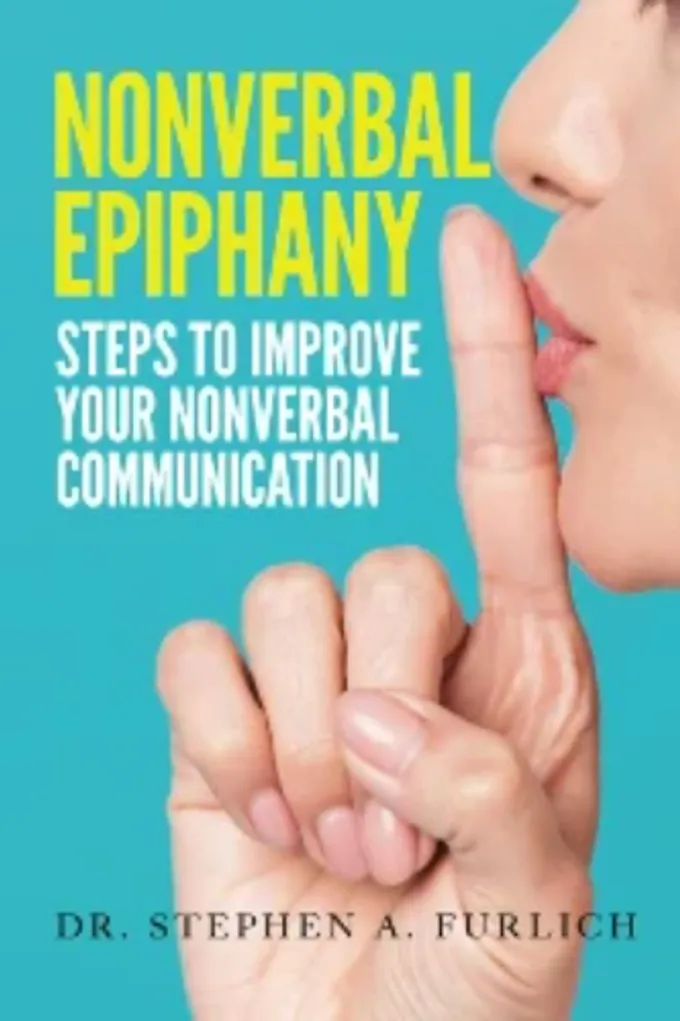
The newest book
Nonverbal Epiphany
Steps to Improve Your Nonverbal Communication
Do you ever wonder why you didn't get the job or a promotion after an interview – or why a business phone call seemed to go so much better than an in-person meeting? When you are on a date or trying to convey a message to a friend, how do you ensure they are fully receiving your intentions correctly?
It may come down not just to what you say – but what is communicated beyond words. A unique book, Nonverbal Epiphany: Steps to Improve Your Nonverbal Communication by Dr. Stephen A. Furlich, provides well-researched answers to these questions and reveals the subtle nonverbal behaviors that often go unnoticed but contribute heavily to the impression one makes.
“The interconnectedness between biology and nonverbal communication is explored deeply here.”
— Dr. Furlich, whose prior book was a best-seller, Sex Talk
Readers will learn how to better notice and understand other people's nonverbal behaviors. They will also learn how to better communicate with their nonverbal behaviors. From teens to senior citizens, anyone can learn to improve their personal and professional nonverbal communication skills. Some areas covered are gestures, facial expressions, vocal changes, colors, and measurement proportions, to mention a few.
Nonverbal Epiphany features chapters on gender communication differences, something he coins as communibiology, understanding emotions, identifying the powers of persuasion without words, the impact of using one's voice artfully, how the colors and setting of your environment influence others, and how nonverbal miscommunications in healthcare can lead to wildly different outcomes.
Dr. Furlich has always been fascinated with communication behaviors that are less obvious. A vast amount of nonverbal communication research involves communication behaviors that are subtle. More effort is needed for a person to recognize these processes.
He explicitly expresses the benefit of applying academic research. It is not enough to only learn about nonverbal communication; one must also develop nonverbal communication skills to communicate more effectively. This book helps readers develop these skills. They range from obvious nonverbal behaviors that most people know about to subtle behaviors that influence perceptions of other people. A more recent research interest for Dr. Furlich is the role of biology in communication. His perspective is that only focusing on social influences limits understanding.